
Vermont DMV Permit Practice Test 4
Test 4 of 10. Pick an answer for each question to see if it is right and why; your score appears at the end. You need 16 correct answers to pass, the same ratio as the real Vermont test.
- Questions20
- Correct to pass16
- Passing score80%
- Minimum age15 years
-
1. At what blood alcohol concentration does Vermont law consider a driver aged 21 or older to be under the influence?
Show answer
Answer C: 0.08 or above
Vermont treats a blood alcohol concentration of .08 or above as being under the influence, although a driver can be impaired at lower levels.
-
2. What is the minimum age to take the test for a Vermont Learner's Permit?
Show answer
Answer B: 15 years old
A Vermont resident must be at least 15 years old to take the learner permit test.
-
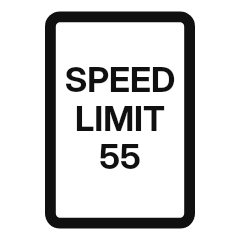
3. Heavy rain has left standing water on the road where this sign is posted. What does the law expect of the driver?
Show answer
Answer C: Driving below the posted figure, at a speed that suits the conditions
Drivers must adapt to conditions, so in rain, fog, snow or dense traffic the safe speed falls below the posted maximum and keeping to that maximum can itself be an offense.
-
4. When a Vermont driver's point total first reaches exactly 10 points within the two year window, how long is the resulting suspension?
Show answer
Answer C: 10 days
Vermont suspends a driver's license for 10 days upon an accumulation of 10 points within a two year period.
-
5. A Vermont driver is on a two-lane road and a marked law enforcement vehicle approaches from behind sounding its siren and displaying blue lights, still moving. What must the driver do?
Show answer
Answer B: Pull to the right side of the lane of traffic and come to a complete stop until the emergency vehicle has passed
Vermont law requires drivers to pull to the right of the lane of traffic and come to a complete stop for an approaching law enforcement or emergency vehicle sounding a siren or showing emergency lights, until it has passed.
-
6. You want to stop briefly and the only space is in the travel lane alongside a vehicle already parked at the curb. Is this allowed?
Show answer
Answer D: No, double parking blocks a travel lane and is prohibited
Stopping in the roadway beside a parked vehicle removes a lane from traffic and forces other drivers to swerve around you, which is why double parking is prohibited.
-
7. When is it appropriate to use cruise control?
Show answer
Answer B: On a dry, open highway with light traffic
Cruise control suits steady conditions where you rarely need to change speed. It is a poor choice in traffic, on curves, on slippery roads or when drowsy, because it removes you from the speed decision.
-
8. At an intersection where turning right on red is permitted and no sign prohibits it, what must you do before turning?
Show answer
Answer A: Come to a complete stop and yield to pedestrians and cross traffic
A right turn on red is allowed only after a full stop, and the turning driver must yield to pedestrians in the crosswalk and to traffic already using the intersection.
-
9. You park a manual transmission car facing uphill at a curb. What is the correct combination?
Show answer
Answer A: First gear, wheels turned away from the curb, parking brake set
Facing uphill the car would roll back, so first gear resists that, the wheels turned out let a tire catch the curb, and the parking brake holds it.
-
10. How much certified driving practice must a Vermont applicant complete before a Junior Driver's License road test?
Show answer
Answer C: 40 hours, with at least 10 at night
Vermont requires 40 hours of driving practice with at least 10 hours at night, in addition to the six behind the wheel hours from driver education.
-
11. Under Vermont's civil suspension law, what is the suspension period when a driver submits to an evidentiary test and the result is at or above the legal alcohol limit?
Show answer
Answer A: 90 days
Vermont imposes a civil suspension of 90 days when a driver's evidentiary test result is at or above the legal alcohol concentration limit.
-
12. Under Vermont's civil suspension law, what happens on a driver's third civil suspension for an alcohol-related offense?
Show answer
Answer D: The driver's license or privilege to operate is suspended for life
Vermont law imposes a lifetime civil suspension for a third or subsequent civil suspension under the implied consent subchapter.
-
13. The signal ahead turns yellow while you are approaching it. What does the yellow light mean?
Show answer
Answer C: The red is coming; stop if you can do so safely
A steady yellow warns that the red is next. Stop if you can do so safely; enter the intersection only when stopping would be dangerous.
-
14. How does heavy cargo on a roof rack change the way a vehicle handles?
Show answer
Answer D: It raises the center of gravity, so the vehicle tips more in turns and needs gentler steering
Weight carried high makes the vehicle lean more and roll over more easily, and extra weight lengthens stopping distance. Drive slower and steer smoothly with a loaded roof.
-
15. How much does Vermont charge to furnish a replacement license after the loss, mutilation, or destruction of the original?
Show answer
Answer A: 24 dollars
Vermont furnishes a replacement license upon receipt of a 24 dollar fee following the loss, mutilation, or destruction of the original.
-
16. A deer suddenly steps onto the road ahead of you at night. What is the safest response?
Show answer
Answer C: Brake firmly and stay in your lane rather than swerving
Swerving at speed often leads to a rollover or a head-on crash that is far worse than hitting the animal. Brake hard, hold your lane and expect more deer to follow.
-
17. Under Vermont's DUI statutes, at what alcohol concentration is an ignition interlock device designed to prevent a vehicle from starting?
Show answer
Answer B: 0.02 or greater
Vermont defines an ignition interlock device as one that prevents a vehicle from starting when the operator's alcohol concentration is 0.02 or greater.
-
18. Why should you set the parking brake even when an automatic transmission is in Park?
Show answer
Answer B: Because it takes the strain off the transmission and holds the vehicle
The parking pawl is a small part carrying the whole vehicle; the parking brake shares that load and holds the vehicle if the pawl fails.
-
19. Under Vermont's handheld device law, what is true about using a GPS or navigation system while driving?
Show answer
Answer A: It is allowed if the system is installed by the manufacturer or securely mounted in the vehicle
Vermont's handheld device law exempts use of a GPS or navigation system that is manufacturer-installed or securely mounted in the vehicle.
-
20. During which period does Vermont law require headlights to be turned on?
Show answer
Answer D: From a half hour after sunset to a half hour before sunrise
Vermont law requires headlights from a half hour after sunset to a half hour before sunrise, and also whenever people or vehicles cannot be seen clearly 500 feet ahead.