
Vermont DMV Permit Practice Test 2
Test 2 of 10. Pick an answer for each question to see if it is right and why; your score appears at the end. You need 16 correct answers to pass, the same ratio as the real Vermont test.
- Questions20
- Correct to pass16
- Passing score80%
- Minimum age15 years
-
1. In Vermont you approach a stopped police or emergency vehicle with flashing lights on a road where you cannot change lanes. What does the law require?
Show answer
Answer A: Slow down and proceed with caution until you are past the stopped vehicle
Vermont requires drivers to proceed with caution and slow down for a stopped vehicle showing flashing blue or red lights, and on a four lane highway to change lanes as well when it can be done safely.
-
2. A former Vermont license holder applies for a renewal license, but their previous Vermont license expired more than three years before the application. What does Vermont require?
Show answer
Answer D: The applicant must pass a satisfactory examination as if applying for the first time
Vermont requires an applicant whose previous license expired more than three years before a renewal application to pass a satisfactory examination, the same as a first-time applicant.
-
3. How should a pregnant driver or passenger wear a seat belt?
Show answer
Answer A: Lap belt below the belly across the hips, shoulder belt across the chest
A properly worn belt protects both mother and baby. The lap portion goes low under the belly, snug across the hip bones, and the shoulder belt crosses between the breasts.
-
4. How long is a Vermont license suspension when a driver's point total reaches 20 points within the two year period?
Show answer
Answer A: 90 days
Vermont's point schedule sets a 90 day suspension for an accumulation of 20 points within the two year window.
-
5. The gates at a railroad crossing are down, and you can see that the road beyond them is clear. What is the correct action?
Show answer
Answer A: Wait until the gates rise completely and the lights go out
Lowered gates mean rail traffic is expected, and driving around them removes the only protection the crossing provides.
-
6. You are slowing to turn right at an intersection and a bicyclist is riding beside your right side in a bike lane. What should you do?
Show answer
Answer D: Let the bicyclist go through the intersection before you begin the turn
Turning across the path of a bicyclist who is going straight causes the classic right-hook crash. The rider continuing straight has the right-of-way over your turn.
-
7. During the first three months with a Vermont Junior Driver's License, what passenger rule applies?
Show answer
Answer A: The driver must drive alone unless a qualifying supervising adult rides in the front seat
For the first three months a Vermont Junior Driver's License holder must drive alone, and passengers are permitted only when a qualifying parent, guardian, instructor or licensed unimpaired adult aged 25 or older rides in the front seat.
-
8. Why is it dangerous to make a left turn from the second lane from the center?
Show answer
Answer C: Because a driver in the lane beside you is turning into the same space
Drivers in the proper turn lane are entitled to that space, and turning across them puts two vehicles into one path through the intersection.
-
9. A sign on a long descent points to a RUNAWAY TRUCK RAMP a mile ahead. What is that ramp for?
Show answer
Answer C: Stopping a vehicle whose brakes have failed
An escape ramp climbs into deep gravel or sand to bring a vehicle with failed brakes to a halt, so no one should stop or park in it.
-
10. When issuing or reinstating a Vermont operator's license, what authority does the Commissioner of Motor Vehicles have regarding restrictions?
Show answer
Answer A: The Commissioner may restrict the license to specified vehicles or to whatever manner the Commissioner deems best
Vermont law lets the Commissioner restrict the privileges granted by a license to one or more specified vehicles or in whatever other manner the Commissioner deems best.
-
11. What is the maximum civil penalty in Vermont for operating a vehicle without the required financial responsibility in effect?
Show answer
Answer A: 500 dollars
Vermont assesses a civil penalty of not more than 500 dollars against a person who operates a vehicle without the financial responsibility required by section 800.
-
12. Under Vermont's handheld device law, when is a driver allowed to hold and use a phone even though the vehicle's motor is still running?
Show answer
Answer C: Once the driver has moved the vehicle to the side of or off the public highway and halted where it can safely and lawfully remain stationary
Vermont's handheld device law does not apply once a driver has moved the vehicle off the public highway and halted in a location where it can safely and lawfully remain stationary, even with the motor running.
-
13. Snow has covered the pavement markings on a two-lane road. How should a driver judge lane position?
Show answer
Answer B: By the tracks of other traffic and the roadside features
With the markings hidden, ruts left by earlier traffic, signs, poles and the line of the shoulder are the best clues to where the lane runs.
-
14. When a Vermont city or town sets its own speed limit on a highway within its jurisdiction after an engineering and traffic investigation, what range must that limit fall within?
Show answer
Answer C: Not less than 25 miles per hour and not more than 50 miles per hour
A Vermont municipality's speed ordinance must set a limit of not less than 25 miles per hour and not more than 50 miles per hour.
-
15. Under Vermont's handheld device law, may a driver touch a securely mounted phone to turn hands-free mode on or off?
Show answer
Answer B: Yes, activating or deactivating hands-free use is allowed without holding the device in either hand
Vermont's law permits activating or deactivating hands-free use through a securely mounted device or an internal vehicle feature, without the operator holding the device in either hand.
-
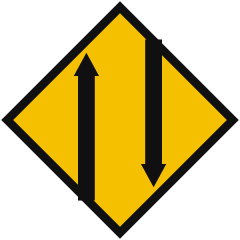
16. Which action becomes clearly more risky beyond this sign?
Show answer
Answer A: Using the left side of the roadway to overtake
With vehicles coming the other way on the same pavement, overtaking on the left needs enough clear road to pull out, pass and return, which is often not available.
-
17. Who is generally prohibited from plowing or depositing snow onto the traveled way of a Vermont State highway or a class 1, 2, or 3 town highway?
Show answer
Answer C: Anyone other than an employee performing official duties or a person authorized by the Agency of Transportation or the selectboard
Vermont bars anyone other than an employee performing official duties, or a person authorized by the Agency of Transportation or a town selectboard, from plowing or depositing snow onto the traveled way, shoulder, or sidewalk of a covered highway.
-
18. A bicyclist in the bike lane ahead of you signals and starts to move left toward the turn lane. What should you do?
Show answer
Answer A: Slow down and let the rider move across
A bicyclist who needs to leave the bike lane to turn left is changing lanes like any driver, and following traffic should make room.
-
19. After the Commissioner mails a notice requiring proof of financial responsibility, how long does a Vermont driver have to furnish that proof before the license is suspended?
Show answer
Answer D: 20 days
Vermont suspends the license of a driver who fails to furnish required proof of financial responsibility within 20 days after the Commissioner mails notice.
-
20. A large truck ahead of you swings toward the left just before turning right at an intersection. What should you do?
Show answer
Answer B: Stay back and never try to move into the gap between the truck and the curb
Long vehicles need extra room and often swing wide to complete a right turn, so the space that opens on their right closes again as the trailer sweeps through it.