
Vermont DMV Motorcycle Practice Test 74
- Questions20
- Correct to pass16
- Passing score80%
- Minimum age16 years
-
1. You are approaching a narrow bridge where the road has one lane in each direction and no shoulder. What should you do about passing?
Show answer
Answer B: Do not pass on or near the bridge
A narrow bridge gives neither vehicle anywhere to go, so passing is prohibited there in the same way as on a hill or in a tunnel.
-
2. What is the what if habit of a defensive driver?
Show answer
Answer C: Thinking through what you would do if a hazard ahead of you turned bad
Rehearsing an answer before the hazard develops means you act at once instead of spending time deciding.
-
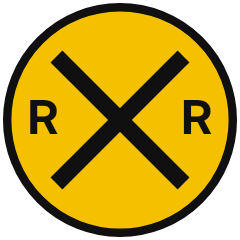
3. This sign leads to a crossing that has no gates and no flashing lights. What does that mean for the driver?
Show answer
Answer D: Nothing will warn of an approaching train, so the driver must check the tracks personally
At a passive crossing there is no active device to announce a train, so the whole judgment rests on the driver, who must approach slowly enough to stop after looking along the track.
-
4. Where must the engine cut-off switch be set before the starter button will crank the engine?
Show answer
Answer A: In the run position
The cut-off switch sits in the ignition circuit, so the engine will not start or run while it is set to off.
-
5. Is a helmet worth wearing on a short trip to a store a few blocks away?
Show answer
Answer C: Yes, since many crashes happen close to home at ordinary street speeds
A large share of motorcycle crashes occur on short, familiar trips at moderate speeds, and injuries at those speeds are still severe.
-
6. A helmet falls from the seat onto a hard floor but shows no cracks. What should the owner do?
Show answer
Answer C: Replace it or have it checked, because the liner can be crushed inside
The foam liner can be compressed with no outside sign, and crushed foam will not absorb a second impact, so a helmet that has taken a hard knock should be replaced.
-
7. You are about to slow down sharply for a turn. Which check comes first?
Show answer
Answer A: A look in the mirror to see how close the traffic behind you is
Any hard slowing needs a mirror check first, because the driver behind is the one who has to react to it.
-
8. With the engine off, a rider turns the handlebars fully to the left and to the right. What is being checked?
Show answer
Answer A: That the steering moves freely and no cable is pinched or binding
Cables and wiring that catch at full lock can hold the throttle open or stiffen the steering exactly when the rider needs a tight turn.
-
9. A sign reads END SCHOOL ZONE. What does it tell a driver?
Show answer
Answer A: The regular limit for that road applies again
An end of restriction sign marks the downstream limit of a special zone, after which the ordinary speed limit for that road governs again.
-
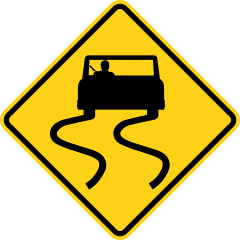
10. Which danger does this sign point out on the road ahead?
Show answer
Answer B: The road surface ahead can lose grip badly when it is wet
It warns that the pavement becomes unusually slick in wet weather, so speed, braking and steering must be gentler there.
-
11. You have just merged onto a freeway from an entrance ramp. What should you do next?
Show answer
Answer C: Settle into the right lane and build up speed before changing lanes
Crossing lanes while you are still below the speed of the traffic forces other drivers to brake, so the speed comes first and the lane change second.
-
12. A pedestrian has stepped into a crosswalk at an intersection ahead of you. What is your obligation?
Show answer
Answer C: Yield and let the pedestrian finish crossing before you proceed
Drivers must yield to pedestrians in a crosswalk, and an intersection has a legal crosswalk whether or not lines are painted on the pavement.
-
13. Why is a pothole a bigger problem for a motorcycle than for a car?
Show answer
Answer C: A motorcycle has only two wheels, so an impact can deflect it off line
A car crosses a hole on four wheels and stays balanced, while a hole can knock a motorcycle off its line or damage a wheel, so scan the pavement well ahead and plan a path around holes.
-
14. A yellow sign ahead of an underpass reads LOW CLEARANCE 12 FT 6 IN. What does the figure tell you?
Show answer
Answer B: The greatest height that can pass beneath the structure
The figure is the actual clearance available, so a vehicle taller than that must leave the road and take a marked alternative route.
-
15. The signal turns green as you approach an intersection. What is the safest practice?
Show answer
Answer B: Look left, then right, then left again, and make sure the intersection is clear before entering
A green light gives permission but does not guarantee the intersection is empty, and a quick scan catches a vehicle running the red or a pedestrian still crossing.
-
16. How do stimulant drugs such as amphetamines or cocaine typically affect driving?
Show answer
Answer D: They can make the driver overconfident and more willing to take risks
Stimulants create a false sense of alertness and encourage aggressive, risky driving. When they wear off, sudden fatigue can follow.
-
17. Traffic is backed up on the far side of a railroad crossing. What should you do before driving onto the tracks?
Show answer
Answer D: Wait behind the tracks until there is room to clear them completely
Never enter a crossing until you are certain you can drive completely across without stopping, because a vehicle trapped on the tracks cannot get out of a train's way.
-
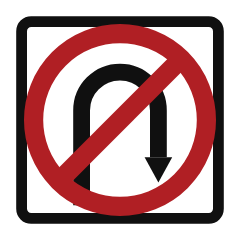
18. Why is this restriction used so often on a divided road just before a crest or a bend?
Show answer
Answer A: Because a vehicle turning across the median there stays hidden from approaching drivers until it is too late
The maneuver needs a long gap and good visibility, and where sight distance is short an approaching driver has no time to react to a vehicle turning across the road.
-
19. About how much alcohol can the body eliminate per hour?
Show answer
Answer A: About one standard drink
The liver removes alcohol at a nearly fixed rate of roughly one standard drink per hour. Drinking faster than that raises the blood alcohol level, and nothing speeds the process.
-
20. A rectangular red sign with the white words WRONG WAY means that
Show answer
Answer C: the driver is already traveling against the legal flow and must not continue
The wrong way sign uses a white legend and border on red and addresses a driver who has entered a ramp or one-way roadway in the wrong direction, who should stop and turn around safely.