
Vermont DMV Motorcycle Practice Test 63
- Questions20
- Correct to pass16
- Passing score80%
- Minimum age16 years
-
1. Under Vermont law, when does driving at 60 miles per hour or more become the separate criminal offense of excessive speed, rather than an ordinary speeding violation?
Show answer
Answer C: When the speed also exceeds the posted State or local speed limit by at least 30 miles per hour
Vermont's excessive speed statute applies only when a driver travels at 60 miles per hour or more and at least 30 miles per hour over the applicable State or local speed limit.
-
2. What does the traffic law actually say about the right of way?
Show answer
Answer B: It says who must yield; no driver is ever entitled to take the right of way
The law describes who must yield. Right of way is something you give; insisting on it when another driver does not yield causes crashes.
-
3. How should you handle a prescription or over the counter medicine before driving?
Show answer
Answer D: Read the label and ask a pharmacist or doctor whether it affects driving
Many common medicines, including allergy and cold remedies, cause drowsiness or slowed reactions, and the label or a pharmacist can tell you whether driving is safe.
-
4. Two solid white lines separate your lane from the lane beside it. What do they mean?
Show answer
Answer B: Crossing from one lane to the other is prohibited
A solid double white line marks a boundary that road users may not cross, such as the entrance to a preferential lane.
-
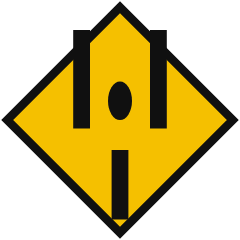
5. What change in the road does this sign announce?
Show answer
Answer B: The two directions of travel are about to be separated, and the driver must keep to the right of the separation
Ahead the roadway splits into separate one-way roadways on either side of a median, so the driver stays to the right of the divider and no longer meets oncoming vehicles.
-
6. Traffic in your lane is backed up and the paved shoulder looks clear. May you drive along it to get past?
Show answer
Answer C: No, the shoulder is not a travel lane
Passing must be done within the roadway; driving on the shoulder to get around traffic is prohibited and surprises anyone entering from the right.
-
7. You are about to slow down sharply for a turn. Which check comes first?
Show answer
Answer A: A look in the mirror to see how close the traffic behind you is
Any hard slowing needs a mirror check first, because the driver behind is the one who has to react to it.
-
8. You have tied a load down with cords that are longer than you need. What should you do with the loose ends?
Show answer
Answer D: Secure the loose ends so nothing can reach the chain, the wheel or the road
A dangling cord can be caught by the rear wheel or the chain and jam it, which can lock the wheel without any warning to the rider.
-
9. For an alert driver, about how long is the reaction time once a hazard has been recognized?
Show answer
Answer A: About three quarters of a second
Reaction alone takes roughly three quarters of a second for an alert driver, and perception takes about as long again, so a second and a half of travel is added before the brakes bite.
-
10. Why should you stay out of an intersection you cannot clear, even on a green light?
Show answer
Answer B: Because you would block cross traffic when their signal turns green
A vehicle stranded in the intersection blocks the cross street when its light turns green, which stalls the whole junction and traps emergency vehicles.
-
11. In which crash must the police always be notified?
Show answer
Answer D: Any crash in which somebody has been injured or killed, whatever the damage
Injury or death always makes a crash reportable, whatever the amount of vehicle damage or the opinions of the drivers.
-
12. A driver is tailgating you. Why is it a bad idea to tap or stab the brakes to warn them?
Show answer
Answer C: Because it cuts the little space they have and can cause a crash
Brake checking removes the small margin the tailgater has left and can provoke a collision; add space in front of you instead and let them pass.
-
13. A driver who is passing you cannot complete the pass because a vehicle is coming. What should you do?
Show answer
Answer C: Ease off the accelerator and make room for them to drop back in
The only place for the passing vehicle to go is the gap behind you, and easing off opens that gap immediately.
-
14. What should you expect while driving through a parking lot?
Show answer
Answer D: Pedestrians and vehicles moving from any direction, so drive slowly
Parking lots mix walking people, reversing vehicles and poor sight lines, so low speed and constant scanning are the only reliable protection.
-
15. You are stopped at a stop sign where your road ends at a two-way through street and you plan to turn left. What must you yield to?
Show answer
Answer B: Traffic from both directions and any pedestrians crossing
A left turn from the stem of a T crosses the near lane and joins the far one, so you give way to traffic in both directions and to pedestrians.
-
16. You are in a passing zone that continues over the crest of a hill ahead. May you start a pass?
Show answer
Answer B: Only if you can finish it well before the crest
Beyond the crest you cannot see oncoming traffic, so any part of the pass that happens there is being made blind.
-
17. At a four-way stop you and an opposing driver arrive together. You are going straight and the other driver is turning left across your path. Who goes first?
Show answer
Answer B: You do, because the left turn crosses your path
When two opposing drivers arrive together, the one going straight goes first and the left-turning driver yields.
-
18. How should a helmet sit on the head once it is fastened?
Show answer
Answer C: Level on the head, with the eye port giving a clear view of the road
A helmet worn level protects the forehead and gives full vision, while one pushed back leaves the forehead exposed in a crash.
-
19. A yellow diamond showing a truck is posted beside a quarry entrance. What is it warning about?
Show answer
Answer A: Trucks turning onto the highway from that entrance
A truck crossing or trucks entering sign is used where heavy vehicles pull onto the road from a site, and they accelerate slowly once they are on it.
-
20. When is a rider ready to start carrying passengers?
Show answer
Answer B: After enough solo experience to handle the machine without thinking
A passenger changes how the machine accelerates, brakes and turns, and only a rider who no longer has to think about the basics has attention to spare for that.