
Vermont DMV Motorcycle Practice Test 45
- Questions20
- Correct to pass16
- Passing score80%
- Minimum age16 years
-
1. You are driving at night on an unlit road using low beams. How should you choose your speed?
Show answer
Answer C: So you could stop within the distance your headlights light up
Driving faster than you can stop within the lit area is called overdriving your headlights. Anything beyond the beam is invisible until it is too late to react.
-
2. On a school speed limit sign, the part carrying the word SCHOOL is shown
Show answer
Answer A: in black on a fluorescent yellow-green background
The SCHOOL portion of the school speed limit sign uses the same fluorescent yellow-green background as school warning signs, while the speed portion keeps the standard regulatory appearance.
-
3. How should a load be distributed between the two saddlebags?
Show answer
Answer B: Evenly, so the weight is balanced from side to side
An uneven load pulls the motorcycle toward the heavy side and makes it behave differently in left turns than in right turns.
-
4. An object thrown up by another vehicle strikes your face shield. What should you do?
Show answer
Answer C: Keep both hands on the handlebars and your eyes on the road, then stop when it is safe to check
Letting go of the handlebars or looking away is far more dangerous than the impact itself, so keep control first and inspect the damage after you have stopped safely.
-
5. You are approaching a yield sign on a ramp that joins a busy street. What does the sign require?
Show answer
Answer A: Slow down, be ready to stop, and let the other traffic go first
A yield sign means you must slow, be prepared to stop and give way to traffic on the road you are entering; a full stop is required only when traffic makes it necessary.
-
6. What is the recommended way to park a motorcycle at a curb?
Show answer
Answer C: At an angle, with the rear wheel touching the curb
Backing the rear wheel to the curb at an angle keeps the motorcycle clear of traffic and lets the rider ride out forward instead of backing into the lane.
-
7. Smoke and flames appear from the engine compartment after you stop. What should you do?
Show answer
Answer A: Get everyone well away from the vehicle first, and then call the fire service
A vehicle fire can spread within seconds, so people come out first and firefighting is left to the fire service.
-
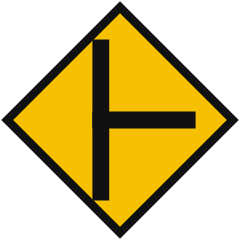
8. Approaching the point this sign refers to, which hazard is most likely?
Show answer
Answer A: A vehicle pulling out from the entering road into the driver's path
The main risk is a driver on the entering road who misjudges the gap and pulls out, so covering the brake and being ready to slow is the sensible response.
-
9. A reduced speed limit posted with this sign and a plaque giving hours is in force

Show answer
Answer C: during the hours shown on the plaque, or while the beacon is flashing
A school speed limit applies during the periods stated on the plaque or while the attached beacon flashes, and the regular limit governs outside those periods.
-
10. What counts as a complete stop at a stop sign?
Show answer
Answer C: The wheels stop turning before the stop line
A legal stop means the vehicle is no longer moving, made at the stop line or before entering the crosswalk or intersection.
-
11. Two roads come together at a shallow angle under a MERGE sign, with no yield line on either one. What is expected of you?
Show answer
Answer D: Adjust your speed and position so you blend smoothly into the other traffic
A merge means neither road ends at a stop; drivers adjust speed and position so that the two streams fit together without stopping.
-
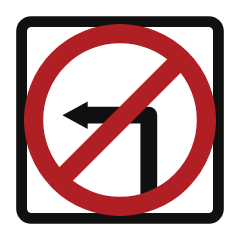
12. A driver in the leftmost lane reaches this sign at an intersection. What must the driver do?
Show answer
Answer B: Go straight on or turn right, and reach the destination another way
The restriction holds whatever the traffic or the signal is doing, so the driver has to pass the intersection and plan a different route.
-
13. A rider signals that they need to stop, although nobody else in the group wants a break. What should happen?
Show answer
Answer A: The group stops, because a rider who needs a break should get one
A rider who is tired, cold or uncomfortable is a hazard to the whole group, and stopping costs far less than the mistake that follows.
-
14. What most often leads to an engine seizure on a motorcycle?
Show answer
Answer A: Loss of engine oil or coolant, so the moving parts overheat and grip
Seizure is normally a lubrication or cooling failure, which is why oil level and coolant are part of every pre-ride check and why a rising temperature reading deserves attention.
-
15. About how far does a vehicle travel in one second at 60 mph?
Show answer
Answer A: About 88 feet
At 60 mph you cover about 88 feet every second, which is why a glance of only two or three seconds means driving the length of several vehicles blind.
-
16. You are riding a shaded back road in autumn and reach a mat of wet leaves covering the pavement. What should you expect?
Show answer
Answer D: Traction can be nearly as poor as ice, so slow down before you reach them
Wet leaves are slick and they hide whatever is underneath, so reduce speed before the patch and cross it upright without braking or turning.
-
17. What is the correct way to secure a load on a motorcycle?
Show answer
Answer C: Fasten it with elastic cords using several attachment points and check it at every stop
Several attachment points hold the load tight so it cannot shift or fall into the wheel or the chain, and checking at stops catches a load that has worked loose.
-
18. How does being tired change your total stopping distance?
Show answer
Answer A: It lengthens it, because you take longer to notice and react
Fatigue stretches perception and reaction time, and every extra fraction of a second is added distance before the brakes even begin to work.
-
19. Your exit from a three-lane highway is about a mile ahead on the right, and you are in the left lane. What should you do?
Show answer
Answer B: Start moving right now, one lane at a time
Plan ahead and change lanes one at a time well before the exit, so you never have to cut across several lanes at the gore.
-
20. An ambulance with lights and siren is coming toward you on an undivided two-lane road. What must you do?
Show answer
Answer A: Pull to the right edge and stop until it passes
On an undivided road, drivers in both directions clear the way, pulling to the right edge and stopping.