
Vermont DMV Motorcycle Practice Test 36
- Questions20
- Correct to pass16
- Passing score80%
- Minimum age16 years
-
1. Well before an intersection, an overhead sign shows a diagram of the lanes with an arrow above each one. What is its purpose?
Show answer
Answer C: To let drivers pick the correct lane in good time
Advance intersection lane control signs display the lane assignment far enough back that drivers can move over calmly instead of at the last moment.
-
2. Why is parking too close to a street corner prohibited?
Show answer
Answer D: Because it hides approaching traffic and pedestrians
A vehicle parked at a corner blocks the view that both drivers and pedestrians need before entering the intersection.
-
3. Does Vermont's move-over and work zone statute reduce an emergency vehicle operator's own duty to drive safely, or limit an officer's authority to direct traffic?
Show answer
Answer B: No, the statute does not relieve that duty or limit an officer's authority to regulate traffic
The statute explicitly states it does not relieve an emergency vehicle operator of the duty to drive with due regard for safety, nor does it limit an officer's authority to regulate traffic.
-
4. A yellow sign shows a truck on a slope with the legend 7 PERCENT GRADE. What should a driver of a heavy vehicle do?
Show answer
Answer A: Select a lower gear before starting down
The percentage shows how steep the descent is, and choosing a low gear at the top lets the engine hold the vehicle back instead of the brakes overheating.
-
5. The vehicle in front of you has stopped and is waiting to turn left, and there is a paved shoulder to the right. May you use it to get by?
Show answer
Answer D: No, in most states a pass may not be made by leaving the paved travel lanes
Passing on the right is normally lawful only inside the marked travel lanes, and most states prohibit driving onto the shoulder to get around a turning vehicle; the few states that allow it attach strict conditions.
-
6. An oncoming car is waiting to turn left across your path at an intersection. What is the safest response?
Show answer
Answer D: Slow, cover the brakes and pick a lane position that keeps an escape path
A car turning left in front of a rider is one of the most common motorcycle collisions, so the rider prepares to stop or swerve rather than trusting the driver to wait.
-
7. What is meant by keeping a space cushion?
Show answer
Answer C: Keeping open space on all sides of your vehicle so you always have somewhere to go
Open space ahead, behind and to the sides gives you time to react and an escape path when a hazard appears, which is the core idea of defensive driving.
-
8. You have a steady green ball to turn left, and the oncoming traffic gets a green left arrow. What does that mean for you?
Show answer
Answer C: Oncoming vehicles will turn across your path, so you must wait
A green ball is permissive, so when the oncoming side receives a protected arrow those vehicles have priority and you must yield until they clear.
-
9. Beyond the levels set for 10, 15, and 20 points, how does Vermont's point suspension schedule continue to increase?
Show answer
Answer D: It adds 30 days to the suspension for each additional 5 points accumulated
Vermont's point-based suspension schedule increases by 30 days for each additional 5 points beyond the levels already set for 10, 15, and 20 points.
-
10. You are riding up an entrance ramp to merge onto a freeway. What should you do?
Show answer
Answer D: Build up to traffic speed on the ramp, then signal and check the blind spot
Matching the speed of freeway traffic before merging avoids forcing others to brake, and a head check covers the area the mirrors do not show.
-
11. You come to a place where a storm has dropped a power line across the road ahead. What should you do?
Show answer
Answer B: Stop well back, keep everyone away from it and report it to the police
A downed line may be live and can energize the ground around it, so keep well clear and let the utility or the police handle it.
-
12. Why is a motorcycle particularly hard for other drivers to judge at night?
Show answer
Answer A: Its single headlight gives no width cues for distance and speed
Drivers judge distance from the spacing between a pair of headlights, and a single lamp gives them nothing to measure, so they routinely misjudge how close and how fast a motorcycle is.
-
13. A driver ahead of you extends the left arm straight out horizontally through the window. What is being signaled?
Show answer
Answer C: A left turn
The left arm held straight out is the standard hand signal for a left turn.
-
14. Which set of qualities should eye protection for riding have?
Show answer
Answer A: Shatter resistant, free of scratches, and sealed against the wind
Riding eye protection has to survive an impact, let you see clearly and keep the air out, which is why plastic face shields and goggles are used instead of ordinary glasses.
-
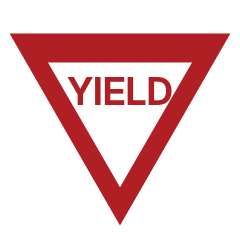
15. Apart from other vehicles, who else must a driver let go first at this sign?
Show answer
Answer A: Pedestrians and cyclists already in or entering the crossing
The duty to give way covers every road user who has the right of way at that point, including people walking or cycling across the driver's path.
-
16. What is the main function of the guide sign series?
Show answer
Answer D: To identify routes and lead road users to their destinations
Guide signs identify routes, name destinations and give distances, so drivers can navigate without stopping to consult a map.
-
17. How should your speed behave while you move from one lane into the next?
Show answer
Answer C: Keep it steady or adjust it smoothly to match the traffic in the new lane
A lane change works best as a smooth movement at the speed of the lane you are joining, since sudden braking or acceleration surprises the drivers around you.
-
18. In near freezing weather, which part of an otherwise clear road is most likely to still be icy?
Show answer
Answer D: A shaded dip under trees or beside a rock cut
Sun clears most of the road, but shaded hollows never warm up and can hold ice long after the rest of the pavement is dry.
-
19. How should a rider adjust speed on an unlit road at night?
Show answer
Answer C: Slow enough to stop within the distance the headlight actually lights up
A rider can only react to what is visible, so night speed has to fit the distance the headlight reaches rather than the posted limit.
-
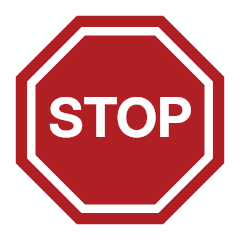
20. A stop line is painted across the pavement at this sign. Where must the vehicle come to rest?
Show answer
Answer A: Behind the stop line, with no part of the vehicle across it
The vehicle must halt behind the stop line; where no line is painted the driver stops before the crosswalk, and where there is neither, before entering the intersection.