
Vermont DMV Motorcycle Practice Test 71
- Questions20
- Correct to pass16
- Passing score80%
- Minimum age16 years
-
1. Your passenger keeps leaning out to one side to see the road ahead. What should you do?
Show answer
Answer B: Ask them to stay in line with you and look over your shoulder instead
Leaning out shifts the combined weight sideways and unsettles the machine, and a passenger can see far enough by looking past the rider's shoulder.
-
2. A vehicle that has not yet been inspected in Vermont is registered in the State. Within how many days of that registration must it be inspected?
Show answer
Answer C: 15 days
Vermont requires a motor vehicle not currently inspected in the State to be inspected within 15 days following the date of its Vermont registration.
-
3. You are overtaking in a short passing lane on a two-lane road and it is about to end. What must you do?
Show answer
Answer A: Finish the pass and move back to the right before it ends
The added lane ends and the traffic returns to a single lane in each direction, so the pass has to be complete before the pavement runs out.
-
4. You come upon a crash that has just happened and decide to help. Where should you stop your vehicle?
Show answer
Answer A: Well beyond the scene, completely off the road, with the hazard lights on
Stopping past the crash and off the pavement keeps you from becoming another victim and leaves the approach clear for emergency vehicles.
-
5. The leader of a group wants to pull the whole group out from a side road into busy traffic. What should the leader do?
Show answer
Answer B: Wait for a gap long enough for every rider in the group to enter
A leader who takes a gap that only fits one machine leaves the rest of the group either stranded or tempted to pull out in front of traffic.
-
6. How should you follow a school bus in traffic?
Show answer
Answer A: Far enough back to see its lights and stop in time
A school bus stops often and with little warning, so a longer following distance gives you time to see the lights come on and stop clear of it.
-
7. A Vermont driver's single incident could technically violate the handheld device law, the texting law, and the junior operator device law all at once. How many complaints may be issued for that one incident?
Show answer
Answer D: No more than one complaint arising from that incident
Vermont law bars issuing more than one complaint for a violation of the handheld device law, the junior operator device law, or the texting law that arises from the same incident.
-
8. The vehicle ahead of you has pulled out to pass a truck. May you follow it out and pass as well?
Show answer
Answer B: No, wait until it is done and judge the road for yourself
You cannot see past the vehicle ahead of you, and if it has to abort the pass there is nowhere for either of you to go.
-
9. On a multi-lane street, a yield line is painted well back from an unsignalized crosswalk rather than right at it. Why?
Show answer
Answer D: So drivers in the other lanes can see the pedestrian
Setting the yield line back keeps a stopped vehicle from hiding a crossing pedestrian from drivers in the next lane, which is a common cause of these crashes.
-
10. You have turned onto a ramp at night and your headlights pick out large white arrows painted on the pavement pointing straight back at you. What do they mean?
Show answer
Answer C: You are traveling against the flow and must turn back
Wrong-way arrows are laid so that a driver going the correct way never sees them head on, so an arrow pointing at you means you are on the ramp backwards.
-
11. How should a group decide how often to stop for fuel?
Show answer
Answer A: By the range of the machine with the smallest fuel tank
Planning around the smallest tank keeps the group from splitting up when one rider has to leave the route to look for fuel.
-
12. Where do the greatest number of collisions involving motorcycles occur?
Show answer
Answer D: At intersections
Intersections concentrate crossing and turning paths, and the most common single event is a car turning left across the path of an oncoming motorcycle.
-
13. Four vehicles reach a four-way stop from all four directions at the same instant. How is the deadlock resolved?
Show answer
Answer C: Each driver yields to the vehicle on the right and they go one by one
Yielding to the right applies to every driver, so the group untangles itself as drivers take turns rather than moving together.
-
14. How many usable riding paths does a single traffic lane offer a motorcycle?
Show answer
Answer C: Three
A lane is normally treated as a left, center and right path, and the rider picks the one that gives the best visibility and the largest space cushion.
-
15. When should most of your braking for a turn be finished?
Show answer
Answer B: Before you begin to turn the wheel
Slow to the right speed before the turn begins; braking hard while turning uses up the grip the tires need for steering.
-
16. Besides air pressure, what should a rider look for when inspecting the tires?
Show answer
Answer B: Tread depth, cuts, embedded objects and uneven wear
Worn or damaged tires lose grip and can fail suddenly, and uneven wear also warns of a pressure or alignment problem.
-
17. You are driving on a two-lane road approaching the crest of a hill. Where should you position your vehicle?
Show answer
Answer D: Toward the right side of your lane, in case an oncoming vehicle is over the center line
You cannot see what is beyond a crest, and oncoming drivers sometimes drift across the center. Keeping right and slowing gives you a margin.
-
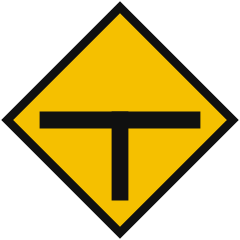
18. What must a driver be prepared to do at the point this sign refers to?
Show answer
Answer D: Turn left or right, because the road being traveled ends there
The road ends at another roadway, so the driver must slow, give way to traffic on the through road and turn in one direction or the other.
-
19. A sign at the approach to a bridge reads WEIGHT LIMIT 10 TONS. What does the figure set?
Show answer
Answer B: The heaviest vehicle the bridge may legally carry
A weight limit sign is a regulation based on what the structure can bear, and it applies to the loaded weight of the whole vehicle.
-
20. Why do streetcar or light rail rails set into a street deserve extra care from a rider?
Show answer
Answer B: The groove alongside the rail can catch a front tire crossed at a shallow angle
The groove beside an embedded rail is just wide enough to trap a motorcycle tire, so cross rails at as steep an angle as your lane allows.