
Vermont DMV Motorcycle Practice Test 50
- Questions20
- Correct to pass16
- Passing score80%
- Minimum age16 years
-
1. You have dropped some distance behind the rest of your group. What should you do?
Show answer
Answer C: Keep your own safe pace, because the group should slow to bring you back
Chasing the group means riding beyond a comfortable pace, so the responsibility sits with the leader to slow down until the formation is whole again.
-
2. Where are children in the greatest danger around a school bus?
Show answer
Answer B: In the roadway right around the bus, especially in front
The danger zone is the band of roadway around the bus where the driver's view is poorest, and children crossing in front of the bus are hardest to see.
-
3. Two drivers each have three drinks, one over three hours and one in half an hour. What is the difference?
Show answer
Answer C: The fast drinker reaches a higher peak level
The liver removes alcohol at a steady rate, so drinking faster than the body can clear it pushes the blood alcohol level much higher.
-
4. A sign with a green background and a white legend normally provides
Show answer
Answer A: directions, distances and destinations
Green is the background color of the guide sign series, which names routes and destinations and gives the distance to them.
-
5. Why does a motorcycle with a manual fuel supply valve have an OFF position?
Show answer
Answer A: It stops fuel reaching the engine while the machine is parked
Shutting the valve keeps fuel from seeping past the carburetor into the engine or onto the ground while the motorcycle stands unused.
-
6. At a freeway exit, the paved triangle between the ramp and the through lanes is filled with diagonal white lines. What do they mean?
Show answer
Answer A: Stay out of that area, because it is not meant to be driven on
Chevron and diagonal markings fill paved areas that traffic is not intended to use, so drivers should keep out of them.
-
7. What is the standard deductible that applies to Vermont's required uninsured motorist property damage coverage, up to its 10,000 dollar per claim limit?
Show answer
Answer A: 150 dollars
Vermont's uninsured motorist property damage coverage is subject to a 150 dollar deductible, up to the 10,000 dollar per claim limit, with exceptions when other direct damage coverage applies.
-
8. When issuing or reinstating a Vermont operator's license, what authority does the Commissioner of Motor Vehicles have regarding restrictions?
Show answer
Answer A: The Commissioner may restrict the license to specified vehicles or to whatever manner the Commissioner deems best
Vermont law lets the Commissioner restrict the privileges granted by a license to one or more specified vehicles or in whatever other manner the Commissioner deems best.
-
9. You are behind three slow vehicles on a two-lane road and the way ahead looks clear. What is the sound decision?
Show answer
Answer D: Pass one vehicle at a time, if the road allows it
Passing several vehicles in one move keeps you in the oncoming lane far too long and leaves nowhere to go if a vehicle appears.
-
10. Traffic is heavy and a truck is stopped in the lane on your right. How do you keep an out?
Show answer
Answer B: Keep space open ahead of you and avoid being boxed in on both sides at once
Being hemmed in on both sides with no gap ahead removes every option, so keep at least one direction open.
-
11. What is the only reliable remedy for a driver who is sleepy?
Show answer
Answer A: Sleep
Caffeine, fresh air and noise may make you feel alert for a few minutes, but they do not remove the need for sleep. Stop somewhere safe and rest.
-
12. A Vermont driver is on a two-lane road and a marked law enforcement vehicle approaches from behind sounding its siren and displaying blue lights, still moving. What must the driver do?
Show answer
Answer B: Pull to the right side of the lane of traffic and come to a complete stop until the emergency vehicle has passed
Vermont law requires drivers to pull to the right of the lane of traffic and come to a complete stop for an approaching law enforcement or emergency vehicle sounding a siren or showing emergency lights, until it has passed.
-
13. You receive a phone call that you feel you must answer while driving. What is the safest way to take it?
Show answer
Answer D: Pull off the road, stop in a safe place and then answer
No call is worth a crash. Stopping in a safe location removes the distraction completely, while every other option divides your attention.
-
14. When must a passenger keep both feet on the footrests?
Show answer
Answer C: At all times, including while the motorcycle is stopped
Feet stay on the footrests even at a stop, because a foot put down or swung out can unbalance the motorcycle or be caught by the road.
-
15. You realize you have just gone past your exit on a freeway. What should you do?
Show answer
Answer C: Carry on to the next exit and turn around there
A missed exit costs a few minutes, while backing up or cutting across the striped gore area puts you in the path of traffic that is not expecting it.
-
16. You and an oncoming driver are both turning left at the same intersection. What is the usual rule?
Show answer
Answer D: Both turn in front of each other unless markings show otherwise
The normal practice is to pass driver side to driver side, turning in front of one another, unless pavement markings or signs direct a different path.
-
17. Which of these is true of the roadway a driver is being sent onto here?
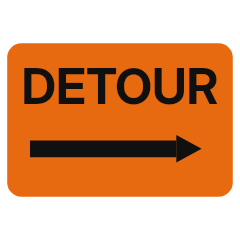
Show answer
Answer D: Its own signs, signals and speed limits govern for the whole way around
The alternate route is an ordinary public road, so every control posted on it governs as usual; being sent that way grants no extra priority and no relief from the limits in force there.
-
18. You are turning left from a two-way street onto another two-way street. Where should you begin and end the turn?
Show answer
Answer B: Begin in the lane just right of the center line and finish just right of the center line of the new street
You approach a left turn from the lane closest to the center line and enter the new roadway just to the right of its center line, which keeps you clear of oncoming traffic.
-
19. While you are still on an entrance ramp, where should your attention be?
Show answer
Answer D: Along the ramp ahead and back at the highway traffic in the mirrors and over your shoulder
A merge needs both halves of the picture at once: the ramp curving ahead of you and the traffic you are about to join behind and to your left.
-
20. Which color scheme is standard for the drums and barricades that channel traffic through a work zone?
Show answer
Answer C: Alternating orange and white retroreflective stripes
Drums and barricades carry alternating orange and white retroreflective stripes, and the traffic cones used in the same zones are predominantly orange.