
Vermont DMV Motorcycle Practice Test 48
- Questions20
- Correct to pass16
- Passing score80%
- Minimum age16 years
-
1. A Vermont motorcycle learner's permit holder fails to pass the applicable skill test or rider training course during the original permit period and both renewals. What happens next, absent an exception?
Show answer
Answer D: The applicant may not obtain another motorcycle learner's permit for 12 months from the expiration of the permit
Vermont bars a person from obtaining another motorcycle learner's permit for 12 months after the original permit and its two renewals expire without a passed skill test, unless the person completes an approved rider training course.
-
2. The trapezoid sign shape is associated with
Show answer
Answer C: recreational and cultural interest area signing
The trapezoid is used for recreational and cultural interest area guide signs and for national forest route markers.
-
3. What does it mean to scan the road while driving?
Show answer
Answer A: Moving your eyes constantly over the road, the sides and the mirrors
Scanning keeps information coming in from every direction, while a fixed stare leaves you blind to everything else.
-
4. A streetcar is coming along tracks in the middle of the street as you wait to turn across them. What should you do?
Show answer
Answer A: Let the streetcar pass before you cross the tracks
Rail vehicles cannot steer around you and need a long distance to stop, so drivers yield to a streetcar or light rail train.
-
5. You reach a stop-controlled intersection at the same time as a driver on your left, but that driver is already moving through the crossing. Who goes first?
Show answer
Answer C: The driver who is already inside the intersection
A vehicle already in the intersection has the right of way, and the rule about yielding to the right applies only before anyone has entered.
-
6. You are approaching an intersection in a line of traffic. What can you do to be more visible to a driver waiting to pull out?
Show answer
Answer D: Move to a lane position where you are not hidden behind the vehicle ahead
A motorcycle tucked directly behind a larger vehicle is invisible to a waiting driver until the moment it appears, so the rider moves to where the headlight can be seen.
-
7. What limits how much weight a motorcycle can carry?
Show answer
Answer A: The load limit given by the manufacturer for that machine
The manufacturer's figure covers the rider, the passenger and everything carried, and going over it overloads the tires, the brakes and the suspension.
-
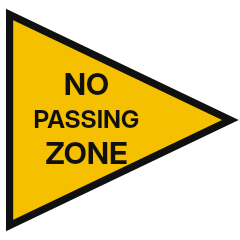
8. A driver is thinking about overtaking a slower vehicle and sees this sign a short distance ahead. What does it mean for that pass?
Show answer
Answer B: The pass must be finished before the restricted section begins
The sign marks the start of a section where passing is prohibited, so a driver may not be on the left side of the road beyond it; any pass has to be completed before that point or not started at all.
-
9. How should a group decide how often to stop for fuel?
Show answer
Answer A: By the range of the machine with the smallest fuel tank
Planning around the smallest tank keeps the group from splitting up when one rider has to leave the route to look for fuel.
-
10. The car ahead of you slows down for no reason that you can see. Should you pull out and pass?
Show answer
Answer B: No, find out why it is slowing before you commit to the other lane
A driver usually slows for something, such as a turn, a hazard or a pedestrian, and that something is often exactly where your pass would take you.
-
11. A friend wants a ride, but their feet do not reach the passenger footrests. What should you do?
Show answer
Answer A: Do not carry them, since they cannot hold a stable position
A passenger who cannot plant both feet on the footrests cannot brace or stay in place, and dangling legs can reach the chain, the exhaust or the wheel.
-
12. Why should reflective material be placed on the front, back and sides of a rider's gear?
Show answer
Answer D: A driver may approach the rider from any of those directions
Threats come from ahead, behind and from the sides at intersections, so reflective material should be visible from every direction a vehicle can approach.
-
13. You enter a work zone at night where one lane is closed and a flagger is on duty. What is the safest approach?
Show answer
Answer A: Slow early, merge before the closure and be ready to stop
Merging early at a reduced speed keeps the queue orderly and leaves you room to stop for equipment, workers or traffic that has halted ahead.
-
14. What do the numbers on a pedestrian countdown display show?
Show answer
Answer A: The seconds remaining to finish a crossing already under way
The countdown runs during the pedestrian change interval and shows how many seconds are left before the crossing time ends.
-
15. How much does Vermont charge to furnish a replacement license after the loss, mutilation, or destruction of the original?
Show answer
Answer A: 24 dollars
Vermont furnishes a replacement license upon receipt of a 24 dollar fee following the loss, mutilation, or destruction of the original.
-
16. How does higher speed affect the outcome of a crash?
Show answer
Answer A: It leaves less time to react and greatly increases the force of impact
Speed shortens the time available to avoid a hazard and raises the energy released in an impact, so both the likelihood and the severity of a crash increase.
-
17. A large group has been divided into smaller groups. What should be done between them?
Show answer
Answer A: Leave a gap big enough for other vehicles to move in and pass safely
A gap between sub groups lets other traffic pass or merge without cutting into a formation, which keeps drivers from making sudden moves around the riders.
-
18. When are you expected to switch from high beams to low beams?
Show answer
Answer D: When a vehicle approaches from ahead or you come up behind another vehicle
High beams blind other drivers, both those coming toward you and those you follow through their mirrors. Dim them whenever another vehicle is within range.
-
19. Which sign tells you that the vehicles ahead are part of a funeral procession?
Show answer
Answer C: Headlights burning in daylight, with small flags or markers on the vehicles
Processions are normally identified by daytime headlights, hazard lights and flags or windshield markers, not by emergency lights or sirens.
-
20. How is the rear brake applied on a standard motorcycle?
Show answer
Answer D: By pressing down a pedal with the right foot
The rear brake pedal is in front of the right footrest and should be pressed down smoothly rather than stamped on.