
Vermont DMV Motorcycle Practice Test 25
- Questions20
- Correct to pass16
- Passing score80%
- Minimum age16 years
-
1. Why should riders avoid the center strip of the lane, especially where traffic stops often?
Show answer
Answer A: Because it collects oil and grease dripped from other vehicles
Drippings from other vehicles build up in the center of the lane, and the buildup is heaviest at busy intersections and toll booths where traffic sits waiting.
-
2. How do strong emotions affect driving?
Show answer
Answer B: They narrow your attention and make risky decisions more likely
Anger, worry and excitement all take attention away from the driving task and push drivers toward decisions they would not normally make.
-
3. About how far ahead do low beam headlights let you see on a dark road?
Show answer
Answer B: About 250 feet
Low beams light roughly 250 feet of road, and high beams roughly 350 to 500 feet, which sets the limit on a safe night speed.
-
4. A downpour has just started on a street with a visible dark strip down the middle of the lane. Where should you ride?
Show answer
Answer A: In the left or right portion of the lane, away from the greasy center strip
Dripped oil and grease build up in the center of the lane, and water floats that film to the top, so the tire tracks on either side offer better grip.
-
5. What should you do with the key and your belongings when you leave the vehicle in a public lot?
Show answer
Answer D: Take the key with you, lock up and put valuables out of sight
Most vehicle thefts are opportunistic: a key left behind or a bag in plain view is the invitation.
-
6. According to national crash research, how effective are helmets at preventing fatal injuries to motorcycle riders?
Show answer
Answer C: About 37 percent effective
Federal estimates put helmet effectiveness at roughly 37 percent for riders and about 41 percent for passengers in preventing fatal injuries.
-
7. You have just been involved in a crash on a city street. Which sequence of first steps is correct?
Show answer
Answer A: Stop where you are, check everyone for injuries, and then make the scene safe
You are required to stop, and the first priority at the scene is people, followed by preventing a second collision.
-
8. A strong wind is blowing steadily across the road from your left. How should you ride?
Show answer
Answer A: Move toward the left of the lane and lean into the wind
Riding on the windward side of the lane leaves room to be pushed without leaving the lane, and a slight lean into the wind holds the line.
-
9. Where is this sign normally installed?
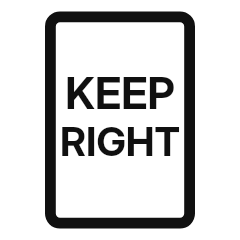
Show answer
Answer A: At an island or other obstruction in the roadway, to show which side traffic must take
It is placed at a divider, island or fixed obstruction so that drivers approaching it know without hesitating which side to pass on.
-
10. How should riders in a staggered formation pass another vehicle?
Show answer
Answer D: One rider at a time
Passing one rider at a time keeps each pass short and prevents the group from occupying the other lane longer than necessary.
-
11. The group has become separated and the leader wants to wait for the missing riders. Where should the leader pull in?
Show answer
Answer C: In a parking area or other space that is clear of moving traffic
Waiting somewhere off the roadway keeps the parked machines and their riders out of traffic and gives the arriving riders room to pull in safely.
-
12. Why is passing on a curve prohibited even when the traffic seems light?
Show answer
Answer C: You cannot see far enough around it to know the lane is clear
A pass is only as safe as the distance you can see, and a curve hides the very lane the maneuver uses.
-
13. What must you check about a load before riding away with it?
Show answer
Answer C: That it does not cover the tail light, the brake light or the signals
Luggage that hides the lights leaves drivers behind with no warning that the motorcycle is slowing or turning.
-
14. Halfway through a curve you realize you are going too fast. What is the best response?
Show answer
Answer C: Ease off the gas gently and look where you want to go
Easing off transfers a little weight to the front tires without upsetting the balance, and looking through the curve keeps your steering smooth.
-
15. How do the traffic laws apply to riders traveling in a group?
Show answer
Answer D: Every rider is responsible for obeying the law on their own machine
Riding in company changes nothing legally, and each rider answers individually for speed, signals and every other rule of the road.
-
16. A motorcycle ahead of you is weaving slightly as it crosses a stretch of grooved pavement. What should you do?
Show answer
Answer D: Give the rider extra room until the surface improves
Grooves, metal plates and loose material affect a motorcycle far more than a car, so back off and let the rider deal with the surface.
-
17. You are riding in the right hand lane of a freeway and vehicles ahead are merging on from an entrance ramp. What is the best response?
Show answer
Answer C: Change lanes if you safely can, or adjust speed to open a gap for them
Merging drivers are looking over a shoulder for a gap and easily miss a motorcycle, so the rider makes room rather than waiting to be seen.
-
18. Where is reflective material most effective at attracting a driver's attention at night?
Show answer
Answer A: On the arms, legs and helmet, where the movement draws the eye
Reflective patches that move as the rider rides are noticed sooner than static ones, and a helmet sits high where drivers are already looking.
-
19. A pedestrian using a white cane or walking with a guide dog starts to cross the street ahead of you. What must you do?
Show answer
Answer A: Yield and stay stopped until the person has finished crossing
A white cane or guide dog identifies a pedestrian who may not be able to see your vehicle, so you must yield and wait rather than maneuver around the person. The horn can confuse the pedestrian or the dog.
-
20. Once you are moving, which way of using a navigation device costs you the least attention?
Show answer
Answer B: Listening to the spoken directions
Voice guidance lets you keep your eyes on the road, while anything that needs the screen takes glances that add up over a trip.