
Vermont DMV permit warm-up test
- Questions20
- Correct to pass16
- Passing score80%
- Minimum age15 years
-
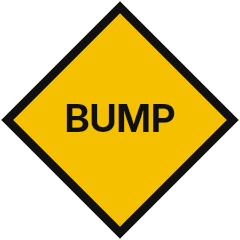
1. How should a driver respond to this sign?
Show answer
Answer C: Slow down before reaching the rough spot and cross it at a steady, low speed
Losing speed before a sharp rise in the pavement keeps the vehicle settled, while braking or accelerating on top of it unsettles the suspension and costs grip.
-
2. How many points does Vermont assess for failing to yield the right of way to a pedestrian in a crosswalk?
Show answer
Answer B: 4 points
Vermont assesses 4 points for failing to yield the right of way to a pedestrian in a crosswalk.
-
3. What does a sign showing a bicycle inside a red circle with a diagonal slash prohibit?
Show answer
Answer D: Riding a bicycle on that roadway
This is a selective exclusion sign, used where bicycles are banned from a road such as a freeway or a tunnel.
-
4. A small signal face beside a bikeway shows red, yellow and green lenses that each carry a bicycle symbol. Whom does it control?
Show answer
Answer C: Bicyclists using that crossing or bikeway
A bicycle signal face governs bicycle movements only, and people on foot at the same corner still follow the pedestrian signal.
-
5. Why is parking next to a fire hydrant or in a marked fire lane prohibited?
Show answer
Answer D: It would delay firefighters who need immediate access to the hydrant or the building
Fire hydrants and fire lanes must remain clear at all times so emergency crews can connect hoses and reach a building without delay.
-
6. In heavy fog at night on a rural two-lane road, which marking best helps a driver hold position?
Show answer
Answer C: The solid white line along the right edge
Steering by the right edge line keeps a driver clear of oncoming traffic, while watching the center line tends to pull the vehicle toward it.
-
7. The crossbuck, formed by two rectangular arms crossed in an X, is placed
Show answer
Answer D: on each highway approach to a railroad grade crossing
The crossbuck marks the location of a highway-rail grade crossing and is required on each highway approach to that crossing.
-
8. You are driving on a rural road with no sidewalk. Where should you expect to meet pedestrians?
Show answer
Answer A: Walking toward you on your side of the road
Where there is no sidewalk, pedestrians are taught to walk facing traffic, so they appear on your side of the road coming toward you.
-
9. You turn from asphalt onto a loose gravel road. What should you do about your speed?
Show answer
Answer D: Lower it, since grip is reduced and stopping takes longer
Loose gravel gives far less grip than pavement, so speed must come down for both steering and stopping.
-
10. You realize you have turned the wrong way onto a one-way street. What should you do?
Show answer
Answer A: Pull to the right, stop, and back into the street you came from when clear
Get out of the traffic stream first: pull right and stop, then back out into the street you came from once you can see it is safe.