
Vermont DMV Permit Practice Test 61
- Questions20
- Correct to pass16
- Passing score80%
- Minimum age15 years
-
1. You want to turn right from a lane marked for through traffic and right turns, and the driver behind you wants to go straight. What should you do?
Show answer
Answer C: Signal, stay in the lane and make the turn when it is safe
A shared lane is the correct place to turn right from, so signal early and turn from the lane; the driver behind must wait or use another lane.
-
2. Traffic is heavy and a truck is stopped in the lane on your right. How do you keep an out?
Show answer
Answer B: Keep space open ahead of you and avoid being boxed in on both sides at once
Being hemmed in on both sides with no gap ahead removes every option, so keep at least one direction open.
-
3. Which shape is used for the school advance warning sign and the school crossing sign?
Show answer
Answer B: An upward-pointing pentagon
The five-sided pentagon with its point up identifies school signing, so the outline alone tells a driver that children may be present.
-
4. Two left-turn lanes are marked at the intersection and you are in the left one. What must you do?
Show answer
Answer A: Stay in your own lane all the way around the turn
With dual turn lanes each driver must hold a lane through the whole turn and come out in the matching lane of the new street.
-
5. You are about to change lanes to the left when you notice a vehicle already overtaking you in that lane. What should you do?
Show answer
Answer A: Hold your lane and your speed, and change only after that vehicle has gone by
A signal asks for space but does not create it, and the overtaking driver has nowhere to go if you move across.
-
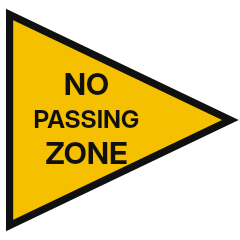
6. A driver is thinking about overtaking a slower vehicle and sees this sign a short distance ahead. What does it mean for that pass?
Show answer
Answer B: The pass must be finished before the restricted section begins
The sign marks the start of a section where passing is prohibited, so a driver may not be on the left side of the road beyond it; any pass has to be completed before that point or not started at all.
-
7. What is the correct first step when parallel parking behind an empty space?
Show answer
Answer D: Signal, pull up alongside the vehicle in front of the space, then back slowly into it
Parallel parking is done in reverse from a position alongside the vehicle ahead of the space, because backing in lets the rear wheels guide the vehicle to the curb.
-
8. What do yellow lines painted on a roadway separate?
Show answer
Answer D: Traffic moving in opposite directions
Yellow markings separate opposing streams of traffic, and they also mark the left edge of a divided highway or a one-way roadway.
-
9. A dust storm is blowing across the highway ahead of you. What is the recommended response?
Show answer
Answer B: Leave the road if you can, park well clear and take your foot off the brake
Get well off the pavement, switch the lights off and keep your foot off the brake, so drivers still on the road do not follow your tail lights off the highway.
-
10. What is the standard deductible that applies to Vermont's required uninsured motorist property damage coverage, up to its 10,000 dollar per claim limit?
Show answer
Answer A: 150 dollars
Vermont's uninsured motorist property damage coverage is subject to a 150 dollar deductible, up to the 10,000 dollar per claim limit, with exceptions when other direct damage coverage applies.
-
11. Why is a shoulder check especially important on a road with motorcycles and bicycles?
Show answer
Answer D: A narrow vehicle can disappear completely in the blind spot
A motorcycle or a bicycle is small enough to be hidden entirely by a door pillar or by the blind spot the mirrors do not cover.
-
12. A short driver cannot get ten inches between the chest and the steering wheel airbag. What is the answer?
Show answer
Answer D: Move the seat back and tilt the wheel downward, or fit pedal extenders
Distance from the airbag is gained by moving the seat back and aiming the wheel at the chest, using pedal extenders if the pedals are then out of reach.
-
13. You have entered a work zone where crews are working close to the open lane. What should you do?
Show answer
Answer A: Slow down and be ready for workers and machines
Workers and equipment cross the open lane without warning in a work zone, so reduced speed and attention on the road ahead are what keep them safe.
-
14. A driver behind you on a two-lane road clearly wants to pass. Why should you not wave that driver past?
Show answer
Answer B: You cannot see the whole road ahead for them and they may rely on your signal
Waving another driver out invites them to trust your judgment of a road you cannot see well enough, and the decision to pass belongs to the driver making it.
-
15. A crossing guard steps into the roadway ahead of this sign with one hand raised. What must the driver do?

Show answer
Answer B: Stop and stay stopped until the guard waves traffic on
An adult guard is controlling traffic at that crossing, so the instruction given by that person governs and the driver waits to be released.
-
16. Traffic is backed up on the far side of a railroad crossing. What should you do before driving onto the tracks?
Show answer
Answer D: Wait behind the tracks until there is room to clear them completely
Never enter a crossing until you are certain you can drive completely across without stopping, because a vehicle trapped on the tracks cannot get out of a train's way.
-
17. A sign reads END SCHOOL ZONE. What does it tell a driver?
Show answer
Answer A: The regular limit for that road applies again
An end of restriction sign marks the downstream limit of a special zone, after which the ordinary speed limit for that road governs again.
-
18. A large truck ahead of you swings toward the left just before turning right at an intersection. What should you do?
Show answer
Answer B: Stay back and never try to move into the gap between the truck and the curb
Long vehicles need extra room and often swing wide to complete a right turn, so the space that opens on their right closes again as the trailer sweeps through it.
-
19. A school sign combined with an AHEAD plaque, or with a plaque giving a distance in feet, forms an assembly that
Show answer
Answer B: warns of a school crossing located further along the road
The school advance crossing assembly is placed before the crosswalk to give drivers notice, while a different assembly marks the crossing itself.
-
20. Where among these is parking specifically prohibited?
Show answer
Answer A: On a bridge, in a tunnel or on railroad tracks
Bridges and tunnels have no safe refuge and cannot be widened, and a vehicle left on railroad tracks cannot be avoided by an approaching train.