
Vermont DMV Permit Practice Test 56
- Questions20
- Correct to pass16
- Passing score80%
- Minimum age15 years
-
1. You are on a country road with no sidewalk and two people are walking toward you on your side of the shoulder. What should you do?
Show answer
Answer C: Slow down and move over to give them room
Where there is no sidewalk, people are expected to walk on the shoulder facing traffic, and drivers must slow and give them space.
-
2. Traffic ahead of you has stopped in your lane while the next lane is still moving. What is the first thing to do?
Show answer
Answer C: Slow down first and check the next lane before moving over
Braking is the action that keeps you from hitting the stopped traffic, and the lane change is only safe once you have looked.
-
3. A sign at the curb reads Tow-Away Zone. What does it mean for you?
Show answer
Answer C: That a vehicle left there can be removed at the owner's expense
In a tow-away zone the vehicle can be removed immediately and the owner pays the towing and storage charges to get it back.
-
4. Another vehicle is passing you on a two-lane road. What should you do with your speed?
Show answer
Answer A: Hold your speed or ease off slightly to shorten the pass
Speeding up strands the passing driver in the oncoming lane, while a steady speed or a slight lift lets the pass finish quickly and safely.
-
5. On a two-way street, where and how should you park at the curb?
Show answer
Answer C: On the right side, facing the way traffic moves
On a two-way street you must park on the right, headed in the direction of travel; parking facing traffic is prohibited.
-
6. You are in the acceleration lane and the gap you were aiming for is now beside you. What is the best adjustment?
Show answer
Answer A: Change your speed a little to line up with a gap, then merge smoothly
The acceleration lane is for matching both the speed and the position of a gap, and small speed adjustments are what line the two up.
-
7. What is lane splitting?
Show answer
Answer B: A motorcycle riding between two lanes of traffic moving the same way
Lane splitting means riding along the line between two lanes of traffic going in the same direction rather than staying within a lane.
-
8. Why are drivers required to turn the front wheels when parking on a grade?
Show answer
Answer A: So that a vehicle that starts to roll leaves the traffic lanes instead of entering them
The wheel position is a last line of defense if the parking brake or transmission fails, directing the vehicle into the curb or off the roadway.
-
9. A lane is marked with a large white bicycle symbol and chevrons, but there is no separate bicycle lane. What does it mean?
Show answer
Answer A: Bicyclists may use the whole lane, so follow or pass with care
A shared lane marking shows that bicyclists and drivers use the same lane and positions riders away from parked car doors, so passing means changing lanes.
-
10. Which family of signs normally uses a rectangle that is wider than it is tall?
Show answer
Answer B: Guide signs, which name routes and destinations
Guide signs are laid out as horizontal rectangles because they have to carry route numbers, place names and distances side by side.
-
11. A Vermont driver is towing a trailer that is exempt from the usual trailer weight requirements. What speed limit applies to that combination?
Show answer
Answer B: 35 miles per hour
Vermont law caps the speed of a vehicle towing a trailer exempted from the weight requirements of section 1307(h) at 35 miles per hour.
-
12. When is a driver at the highest risk of falling asleep at the wheel?
Show answer
Answer B: Late at night, early morning and mid afternoon
The body clock produces its deepest dips in alertness in the small hours and again in the middle of the afternoon, and crash records follow those dips.
-
13. You are turning left from a divided highway through a median opening into a business on the other side. Who has the right of way?
Show answer
Answer C: The traffic on the roadway you are crossing
Turning through a median opening means crossing the opposite roadway, so you yield to all traffic on it before you go.
-
14. You have brought the vehicle under control after a blowout. What should you do next?
Show answer
Answer A: Signal and coast well off the road before stopping
Let the speed fall, signal, and leave the roadway as far from traffic as you can before you stop. Driving on a failed tire ruins the wheel and risks control.
-
15. You realize you have turned the wrong way onto a one-way street. What should you do?
Show answer
Answer A: Pull to the right, stop, and back into the street you came from when clear
Get out of the traffic stream first: pull right and stop, then back out into the street you came from once you can see it is safe.
-
16. A driver reaches this sign and the intersecting roadway is completely clear. What is required?
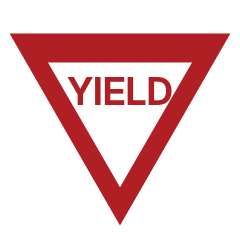
Show answer
Answer D: Slowing to a speed that allows stopping, then going on without stopping if the way stays clear
This control asks the driver to slow down and be ready to stop, and a full stop becomes necessary only when traffic or pedestrians would otherwise be interfered with.
-
17. Why is parking next to a fire hydrant or in a marked fire lane prohibited?
Show answer
Answer D: It would delay firefighters who need immediate access to the hydrant or the building
Fire hydrants and fire lanes must remain clear at all times so emergency crews can connect hoses and reach a building without delay.
-
18. A speed limit sign carries a second panel reading TRUCKS 55. What does that panel do?
Show answer
Answer B: It sets a lower legal limit for trucks
A truck speed limit panel is regulatory, so trucks are bound by the lower figure while other traffic keeps to the main limit.
-
19. The gates at a railroad crossing begin to come down as you approach. What must you do?
Show answer
Answer A: Stop and wait until the gates are fully raised and the lights stop flashing
Once the gates start down you must stop clear of the tracks and wait until they are fully raised and the warning lights have stopped.
-
20. A small signal face beside a bikeway shows red, yellow and green lenses that each carry a bicycle symbol. Whom does it control?
Show answer
Answer C: Bicyclists using that crossing or bikeway
A bicycle signal face governs bicycle movements only, and people on foot at the same corner still follow the pedestrian signal.