
Vermont DMV Permit Practice Test 20
- Questions20
- Correct to pass16
- Passing score80%
- Minimum age15 years
-
1. A Vermont learner's permit holder is adjudicated of operating outside the scope of a restricted license, in violation of section 614(c), or of operating without a required supervising driver, in violation of section 615(a). What happens to the permit?
Show answer
Answer B: It is recalled for 90 days
Vermont recalls a learner's permit or junior operator's license for 90 days when its holder is adjudicated of a violation of section 614(c) or 615(a) of the title.
-
2. A yellow curve warning sign carries a yellow plaque showing a speed. What does that number mean?
Show answer
Answer D: The recommended maximum safe speed for the curve under ideal conditions
An advisory speed plaque on a yellow warning sign gives the recommended maximum speed for the hazard ahead when conditions are good.
-
3. At an intersection the signal flashes red toward you and flashes yellow toward the cross street. Who must yield?
Show answer
Answer D: You must, because the flashing red faces your road
A flashing red means stop and yield like a stop sign, while a flashing yellow lets the other road proceed with caution.
-
4. Your right wheels drop off the edge of the pavement onto a soft shoulder. What should you do?
Show answer
Answer C: Ease off the accelerator, hold the wheel straight and steer back gently once you have slowed
Yanking the wheel while the tires are pressed against a pavement lip can throw the vehicle across the road, so slow down first and then make a gentle correction.
-
5. May you park at the curb immediately next to a railroad crossing?
Show answer
Answer A: No, you must leave the crossing and its approach clear
Parking beside a crossing hides the tracks and the signals from approaching drivers and leaves no room for a vehicle that has to clear the rails.
-
6. Which common non-prescription medicine is most likely to make a driver drowsy?
Show answer
Answer C: A cold or allergy remedy containing an antihistamine
Antihistamines in cold and allergy remedies are a leading cause of drowsiness behind the wheel, which is why the label carries a warning.
-
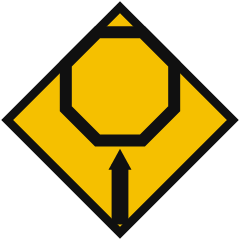
7. On a wet road, how should a driver adjust after passing this sign?
Show answer
Answer B: Start braking earlier, because a slippery surface lengthens the stopping distance
A wet surface lengthens stopping distance, so the extra warning distance should be spent braking gently and early instead of late and hard.
-
8. How much clear road do driver manuals say you need before starting a pass at highway speed on a two-lane road?
Show answer
Answer C: Enough to complete the pass and return, roughly ten to twelve seconds of travel
At highway speed the whole maneuver of pulling out, overtaking and returning takes roughly ten to twelve seconds, and every foot of that has to be visible before you start.
-
9. At roughly what speed can hydroplaning begin when a lot of water is lying on the road?
Show answer
Answer C: At speeds as low as about 35 mph
With enough water and less than perfect tread, a tire can start to ride on the water at around 35 mph, well below normal highway speeds.
-
10. What is the best way to keep your phone from distracting you on a trip?
Show answer
Answer D: Silence it and stow it before you start
A phone you cannot hear and cannot reach cannot tempt you, which is far more reliable than deciding case by case while you drive.
-
11. How long can cannabis affect a driver?
Show answer
Answer A: For hours after the strongest effects have passed
Slowed reactions, poor tracking and weak judgment of distance can last for hours, well beyond the point where the user believes the effects are over.
-
12. Traffic in your lane is backed up and the paved shoulder looks clear. May you drive along it to get past?
Show answer
Answer C: No, the shoulder is not a travel lane
Passing must be done within the roadway; driving on the shoulder to get around traffic is prohibited and surprises anyone entering from the right.
-
13. The cars in front of and behind your parallel parked car have left you very little room. How do you get out?
Show answer
Answer D: Ease back and forth, turning the wheels each way, until you clear
Short movements with the wheels turned first one way and then the other walk the car out of a tight space without touching anything.
-
14. What may the Vermont Commissioner of Motor Vehicles require before a motor vehicle inspection is performed?
Show answer
Answer B: Evidence that financial responsibility is currently in effect
Vermont allows the Commissioner to require that evidence of financial responsibility be produced before a motor vehicle inspection is performed.
-
15. Why is heavy braking a poor idea while two wheels are still on a soft shoulder?
Show answer
Answer B: The two sides have different grip, so the vehicle can pull sharply
With one pair of wheels on pavement and the other on loose material, hard braking slows one side more than the other and swings the vehicle around.
-
16. You have started to pass and you see the no-passing zone beginning ahead. What should you do?
Show answer
Answer D: Ease off, drop back and return to your own lane
A pass must be completed before the no-passing zone starts. If it will not fit, abandon it and slot back in behind.
-
17. A yellow diamond shows a car with wavy lines behind its rear tires. What is the warning?
Show answer
Answer D: The surface loses grip badly when it is wet
The slippery when wet sign marks a stretch where traction falls off sharply in rain, so speed and braking must be reduced well in advance.
-
18. Your vehicle is burning at the roadside. How far away should everyone keep?
Show answer
Answer D: At least a hundred feet away from the vehicle and upwind, out of the drifting smoke
Burning vehicles give off toxic smoke and parts such as tires and struts can burst, so keep a long distance and stay upwind.
-
19. You have to leave a trailer parked on a slope. What extra step protects it?
Show answer
Answer D: Chock the trailer wheels as well as setting the brake
Chocks physically block the wheels, which is the only thing that still holds if a brake or a coupling lets go.
-
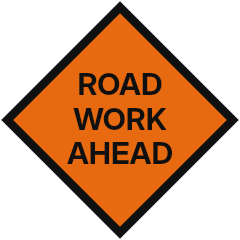
20. How should speed and following distance be adjusted beyond this sign?
Show answer
Answer D: Cut speed and leave a longer gap, because traffic can stop without warning
Traffic in these areas stops and starts unexpectedly and there is little room to steer around a problem, so extra space is what prevents a rear-end collision.